AOD-9604: A Research Overview
What AOD-9604 is, where it came from, and what laboratory research does and does not support about this growth-hormone fragment.
Read article
How the KLOW blend is defined, what its four components are, and why a blend name, a label claim and measured batch composition are different things.
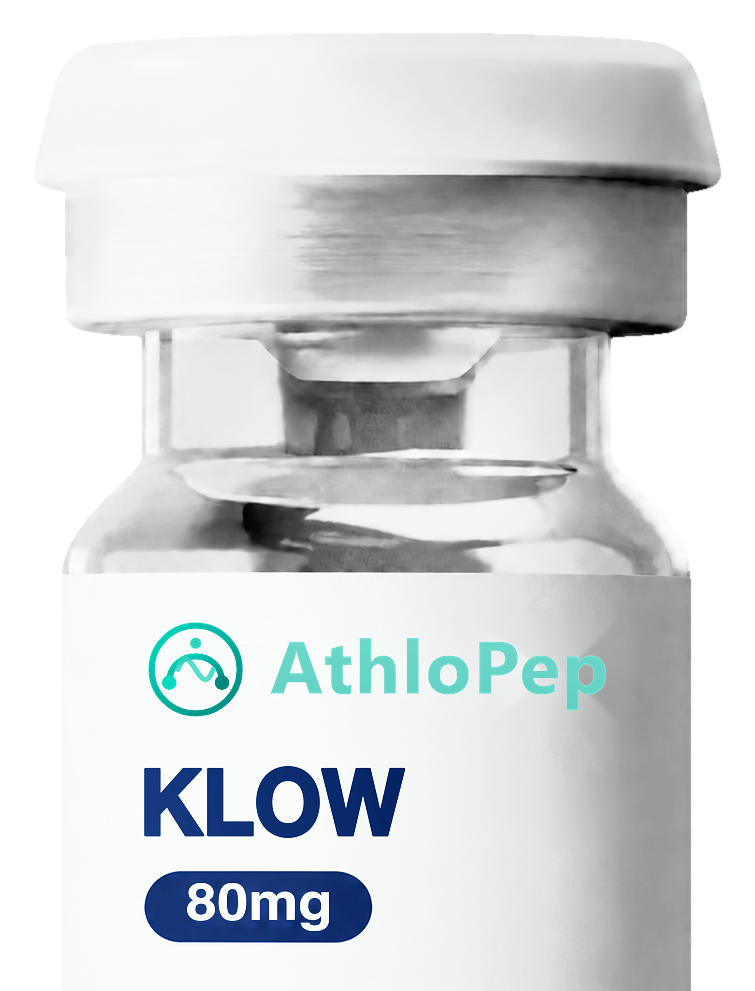
KLOW combines GHK-Cu, BPC-157, TB-500 and KPV. Learn how to distinguish the blend name, labelled amount, measured batch composition and evidence for its separate ingredients. Research Use Only.
Buy KLOW in Australia · view product options
Check current availability and choose options on the product page. Research Use Only.
KLOW is a name used for research blends containing GHK-Cu, BPC-157, TB-500 and KPV. It is a mixture, not a single molecular entity, and the name alone does not specify component amounts or analytical results. Research on the separate ingredients does not establish the behaviour of the finished blend. Research Use Only.
GHK‑Cu binds copper ions and has been shown in vitro to modulate signalling pathways involved in extracellular matrix remodelling; BPC‑157 is a 15‑amino‑acid fragment derived from a gastric protein and interacts with pathways linked to angiogenesis and cellular migration; TB‑500 is a synthetic version of thymosin β‑4 that can bind actin and influence cytoskeletal dynamics; KPV is a tri‑peptide fragment of the neuropeptide α‑MSH that can engage melanocortin receptors implicated in inflammation modulation. In a blend, each of these interactions would still be expected to occur, but the net effect depends on whether the peptides remain chemically intact and accessible to their targets when mixed.
The peer‑reviewed literature contains multiple cell‑culture experiments for the individual peptides. GHK‑Cu has been reported to up‑regulate collagen‑producing genes in fibroblasts; BPC‑157 has been observed to protect cultured endothelial cells from oxidative stress; TB‑500 has been shown to enhance migration of keratinocytes in scratch‑wound assays; KPV has been demonstrated to reduce production of pro‑inflammatory cytokines in immune‑cell lines. None of these studies included a mixture of the four peptides, so there is no direct evidence on how the blend behaves at the cellular level.
In rodent models, GHK‑Cu has been linked to modest improvements in skin‑fold thickness, BPC‑157 to accelerated tendon repair, TB‑500 to enhanced muscle‑fibre regeneration, and KPV to decreased inflammatory cell infiltration in arthritis models. Each study administered the peptide alone, often by injection, and reported outcomes specific to that molecule. No published animal experiment has administered a pre‑mixed GHK‑Cu/BPC‑157/TB‑500/KPV preparation, so the in‑vivo profile of a KLOW blend remains uncharacterised.
There are no peer‑reviewed human studies that evaluate a combined GHK‑Cu/BPC‑157/TB‑500/KPV formulation. For the individual peptides, the literature includes a limited number of early‑phase investigations, typically focused on pharmacokinetics or safety endpoints, but these do not address the behaviour of a multi‑peptide mixture.
Operator’s desk: The KLOW label appears mainly in informal online discussions; no regulatory agency or peer‑reviewed source has defined the formulation, which means its composition cannot be assumed.
The information provided herein is for research and educational purposes only. The KLOW blend is not listed on the Australian Register of Therapeutic Goods (ARTG) and is not approved for human or animal consumption. All handling should comply with applicable Australian regulations for research‑grade substances, and any experimental use must be conducted under appropriate institutional oversight.
This compound is supplied for in vitro laboratory and educational research only. It is not listed on the Australian Register of Therapeutic Goods (ARTG) and is not a therapeutic good under the Therapeutic Goods Act 1989 (Cth). Not for human or animal consumption, therapeutic use, or diagnostic procedures. By purchasing, you confirm you are a qualified researcher or acting on behalf of a licensed research facility, and you assume full responsibility for the safe handling, storage, and lawful use of this compound.
What AOD-9604 is, where it came from, and what laboratory research does and does not support about this growth-hormone fragment.
Read article
A research-focused look at the synthetic tetrapeptide Epitalon, its study context, and what telomere research can responsibly support.
Read article
An evidence-led overview of Selank, its origin as a tuftsin analogue, and the boundaries of the research around stress and immune signalling.
Read article
A summary of KPV (Lys-Pro-Val), the cell and animal research behind it, and the limitations of the existing evidence.
Read articleTell us what you need. An email address is required so we can reply.