AOD-9604: A Research Overview
What AOD-9604 is, where it came from, and what laboratory research does and does not support about this growth-hormone fragment.
Read article
Why these two peptides are often paired in growth-hormone research, and how two different receptor targets relate to the same endocrine axis.
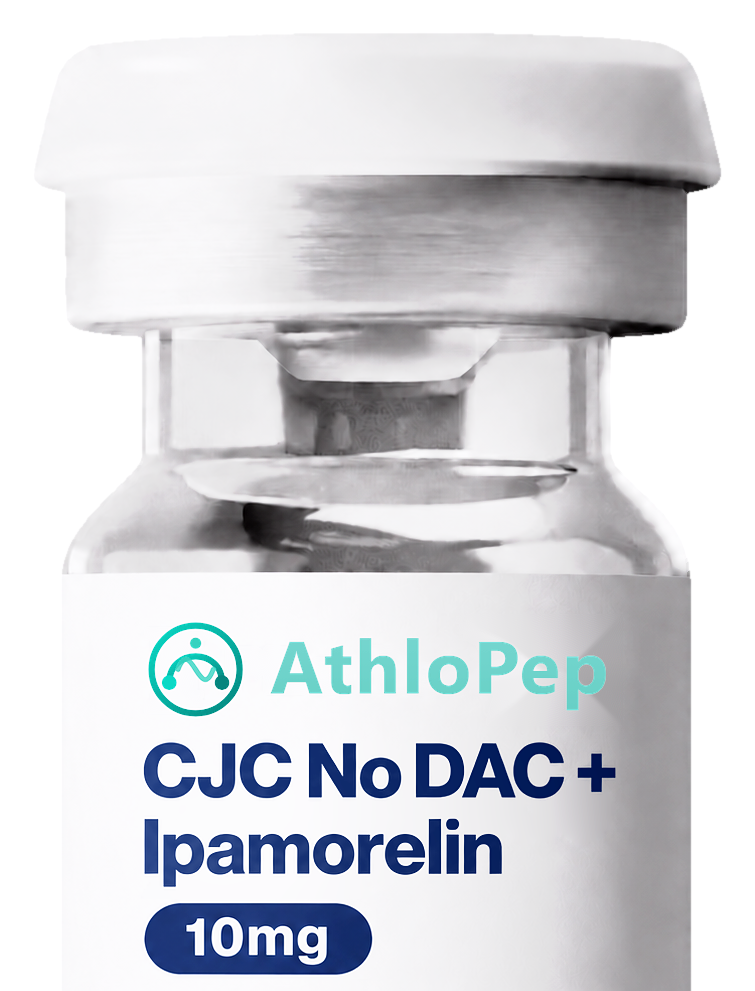
CJC-1295 and Ipamorelin get paired often enough in research discussion that the combination has its own nickname: the "GH stack." The reason comes down to two different receptors feeding the same axis.
Check current availability and choose options on the product page. Research Use Only.
"GH stack" is one of the more common phrases you'll come across in growth-hormone-axis peptide research discussion, almost always referring to one specific pairing: CJC-1295 and Ipamorelin. Unlike some peptide nicknames that are purely aesthetic, this one is descriptive of an actual mechanism-level rationale - the two compounds act on two different receptors that both feed into GH secretion.
The product name needs one important distinction: 's CJC No DAC + Ipamorelin 10mg blend contains 5mg of each component and no DAC. The DAC-form research discussed below is different and does not verify that blend. Separate CJC-1295 with DAC and Ipamorelin 10mg listings remain distinct. Research Use Only.
CJC-1295 (with DAC) is a synthetic analogue of GHRH(1-29), the growth-hormone-releasing hormone. It targets the GHRH receptor on pituitary somatotrophs, and its DAC modification - a maleimidopropionic acid linker - lets it bind circulating albumin, extending its active half-life from minutes to days.
Ipamorelin is a selective pentapeptide agonist of the ghrelin receptor (GHS-R1a) - a completely separate receptor from GHRH-R, but one that also triggers GH release when activated. Published research also describes Ipamorelin as having a non-stimulatory profile in ACTH and cortisol assays, which distinguishes it from earlier-generation growth-hormone-releasing peptides (GHRPs) that showed more off-target receptor activity.
Because CJC-1295 and Ipamorelin enter the growth-hormone axis through two distinct receptor systems - GHRH-R and GHS-R1a respectively - studying them together lets researchers examine how the two pathways interact when both are engaged, rather than only observing each receptor's effect in isolation. That's the actual research logic behind the "GH stack" pairing, independent of the nickname.
Individually, CJC-1295 has published data demonstrating significant, sustained increases in GH and IGF-1 levels persisting for six to eight days from a single dose in preclinical models. Ipamorelin's research base focuses on its receptor selectivity and the GH pulse pattern it produces via GHS-R1a activation. Dedicated combination studies - measuring the two compounds administered together rather than each alone - are less common in the published literature than the individual mechanism-of-action data for each compound.
As with most peptide combination research, the open question is whether dual-receptor engagement produces additive, synergistic, or simply parallel effects on GH secretion - a question that requires dedicated combination-arm studies rather than inference from separate single-compound data.
CJC-1295 and Ipamorelin are supplied by for in vitro laboratory research use only, under the Research Use Only (RUO) framework. Neither is listed on the Australian Register of Therapeutic Goods (ARTG), and neither is intended for human or animal consumption, therapeutic use, or diagnostic procedures.
Researching the GH axis? View CJC-1295 with DAC and Ipamorelin , or see the CJC-1295 catalogue page , which compares the individual and combined research listings.
It does not contain the DAC form discussed above. For separate materials, see CJC-1295 No DAC 10mg and Ipamorelin 10mg . The 10mg blend total is not 10mg of each ingredient, and separate-component studies do not establish the behaviour of the finished blend. Research Use Only.
Links lead to the original paper, DOI record, or open-access full text where available.
This compound is supplied for in vitro laboratory and educational research only. It is not listed on the Australian Register of Therapeutic Goods (ARTG) and is not a therapeutic good under the Therapeutic Goods Act 1989 (Cth). Not for human or animal consumption, therapeutic use, or diagnostic procedures. By purchasing, you confirm you are a qualified researcher or acting on behalf of a licensed research facility, and you assume full responsibility for the safe handling, storage, and lawful use of this compound.
What AOD-9604 is, where it came from, and what laboratory research does and does not support about this growth-hormone fragment.
Read article
A research-focused look at the synthetic tetrapeptide Epitalon, its study context, and what telomere research can responsibly support.
Read article
An evidence-led overview of Selank, its origin as a tuftsin analogue, and the boundaries of the research around stress and immune signalling.
Read article
A summary of KPV (Lys-Pro-Val), the cell and animal research behind it, and the limitations of the existing evidence.
Read articleTell us what you need. An email address is required so we can reply.