Glutathione: The Body's Own Antioxidant Peptide
Why glutathione draws research interest as an endogenous antioxidant, and how its cellular levels are studied in the lab.
Read article
How Melanotan II interacts with melanocortin pathways involved in pigmentation, and what researchers actually examine.
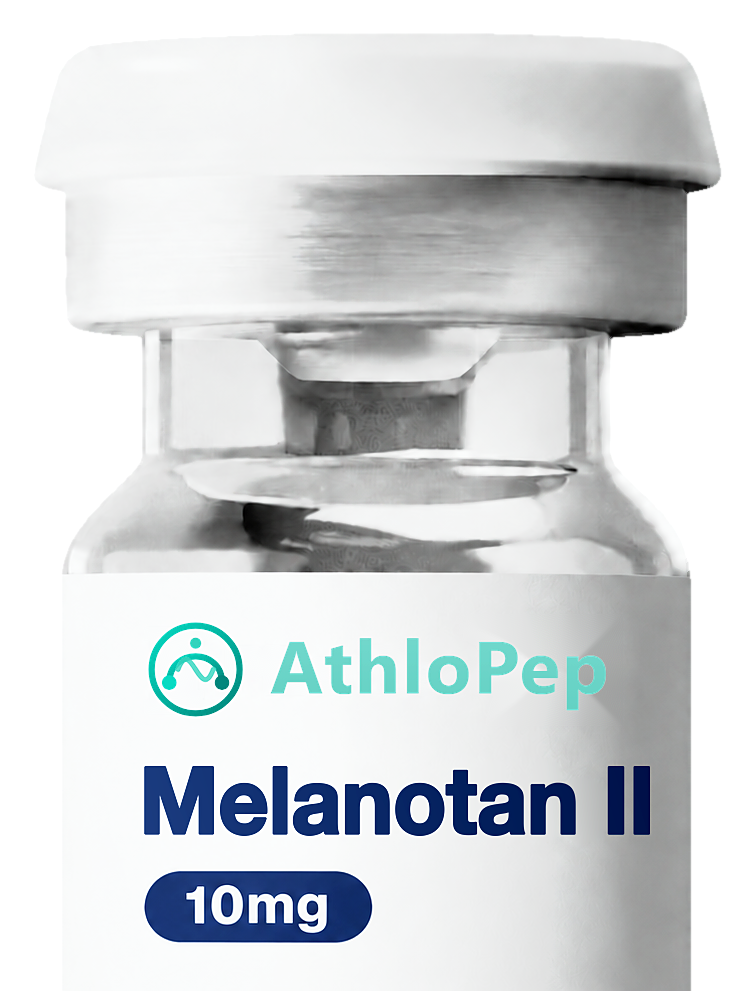
Melanotan II is built to mimic a hormone your body already makes to control skin colour. Here's the plain-English version of how it works, and what researchers are actually finding.
Buy Melanotan II (MT2) in Australia
Check current availability and choose options on the product page. Research Use Only.
Your skin already has a built-in system for controlling pigment: a hormone called alpha-MSH that tells skin cells to produce more melanin, the pigment that darkens skin. Melanotan II is a lab-made peptide built to mimic that hormone, but in a sturdier form that lasts longer in the body. That's the whole idea behind it, and it's why researchers have spent years studying exactly how it behaves once it locks onto a cell.
It is also commonly referred to as MT2, MT-2, or Melanotan 2. . Research Use Only.
Strip away the chemistry and Melanotan II is a small, ring-shaped peptide - its circular structure is actually the trick that makes it more stable than the natural hormone, which breaks down fast in the body. It's built to bind to a family of cell surface docking points called melanocortin receptors, mainly two of them: MC1R, found on skin pigment cells, and MC4R, found mostly in the brain.
Think of MC1R as a light switch on the surface of a pigment cell. Under normal conditions, your body's own alpha-MSH flips that switch on and off as needed. Melanotan II is built to flip the same switch, but because its ring structure resists the enzymes that normally chew up peptides, the switch stays flipped for longer. That extended activation is what researchers believe drives the pigmentation effects associated with the compound. Separately, MC4R sits mostly in brain tissue involved in appetite regulation, which is why some research has also looked at appetite-suppressing effects when this receptor is activated.
Laboratory binding studies confirm Melanotan II activates both MC1R and MC4R, and cell-based pigmentation assays consistently show increased melanin production when skin cells are exposed to the peptide. Animal studies have extended this, looking at pigmentation changes across different models and confirming that the cyclic structure holds up well against enzymatic breakdown compared to linear alpha-MSH fragments. Human data remains limited to small, early-phase studies, and researchers are still mapping how consistent the effects are across different skin types and exposure levels.
A regular suntan is your skin's defensive reaction to UV damage - melanin production ramps up because your body is trying to protect itself from harm. Melanotan II research is interested in whether pigmentation can be triggered through the same receptor pathway without that UV exposure, since it engages the hormone receptor directly rather than as a stress response. This receptor-first mechanism is exactly what makes it interesting as a research tool for studying pigmentation biology independent of sun damage.
The biggest open questions are around long-term receptor behaviour - does repeated activation change how MC1R and MC4R respond over time - and how findings from animal and cell studies translate to broader human physiology. Selectivity is also still being refined: because Melanotan II activates multiple melanocortin receptors rather than just one, researchers are working on understanding the full picture of what that broader activation means.
Melanotan II also sits inside a broader family of melanocortin research compounds. Its linear derivative bremelanotide, studied under the code name PT-141 , was developed from the same parent hormone and is investigated against overlapping melanocortin receptor targets - laboratories comparing MT-II binding data often reference the PT-141 profile alongside it.
The Melanotan II 10mg listing links to the published Janoshik report for the documented batch. Check that report’s sample identity, date and results rather than treating research findings as a guarantee about a supplied vial.
Melanotan II is supplied for in vitro laboratory research purposes only. It is not listed on the Australian Register of Therapeutic Goods (ARTG) and is not intended for human or animal consumption. All experimental work should follow institutional safety guidelines and applicable regulations.
Researching melanocortin receptor pharmacology? View Melanotan II 10mg for vial details, price and Australian delivery information. Research Use Only.
Links lead to the original paper, DOI record, or open-access full text where available.
This compound is supplied for in vitro laboratory and educational research only. It is not listed on the Australian Register of Therapeutic Goods (ARTG) and is not a therapeutic good under the Therapeutic Goods Act 1989 (Cth). Not for human or animal consumption, therapeutic use, or diagnostic procedures. By purchasing, you confirm you are a qualified researcher or acting on behalf of a licensed research facility, and you assume full responsibility for the safe handling, storage, and lawful use of this compound.
Why glutathione draws research interest as an endogenous antioxidant, and how its cellular levels are studied in the lab.
Read article
The origins of Semax in neuropeptide research and its use as a tool for studying BDNF-related signalling.
Read articleA plain-language look at the regulatory context for research-use peptides in Australia and what labs should verify when sourcing compounds.
Read article
GLOW brings three research peptides together. A careful look at what each component is studied for, and why blend evidence is not the same as single-compound evidence.
Read articleTell us what you need. An email address is required so we can reply.